
The fascinating images below are featured in the Society’s 2018 Nautical Heritage Calendar, which is available to purchase online.
These images, and detailed descriptions and histories of each vessel, are reproduced here with the kind permission of the British Mercantile Marine Memorial Collection.
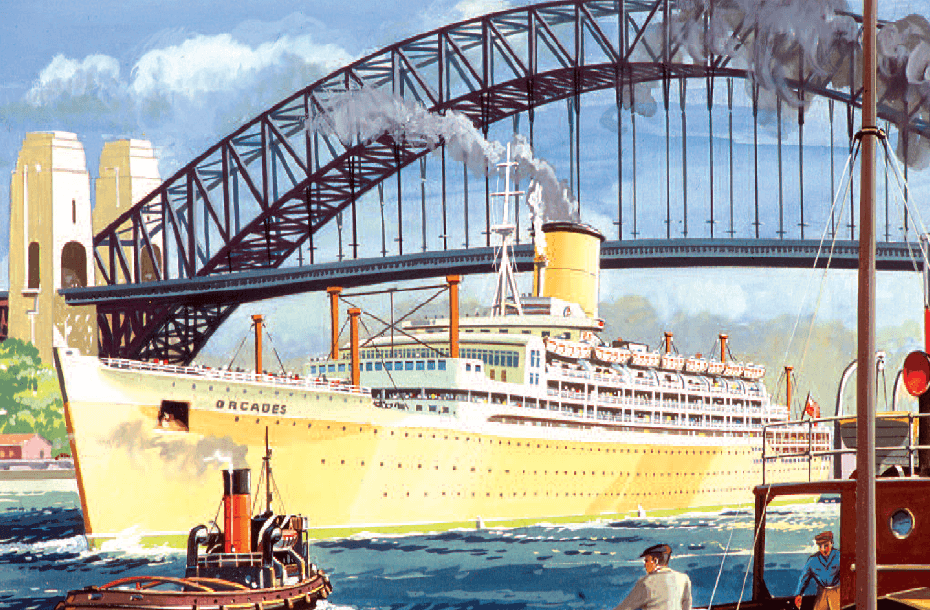
The passenger – and refrigerated cargo-liner ORCADES was built in 1948 by Vickers-Armstrong Ltd. of Barrow-in-Furness for the UK-Australia service of the Orient Steam Navigation Co. Ltd. of London, she being the company’s first new building following the Second World War and their third successive ship to bear this, the Latin name for the Orkney Islands. On her maiden voyage she reduced the pre-war passage time from London to Melbourne from 36 days to 28 and in service she regularly completed four round voyages each year. In 1960 she was transferred to P&O-Orient Lines, formed to operate jointly the passenger vessels of both Orient and its majority shareholder, the Peninsula & Orient Steam Navigation Co., and in 1962, when P&O acquired the outstanding minority shareholding in Orient, she passed wholly to the ownership of P&O. In February, 1973 she was sold to be broken up in Kaohsuing, Taiwan.
By the marine artist and illustrator T.E. North, of whom no biographical details are known but who is thought to have been Australian. Here he shows ORCADES passing under the ‘Coat Hanger’, as Sydney Harbour’s world-famous bridge is colloquially known, a portrait that clearly pre-dates 1954 when ORCADES’ funnel was fitted with a distinctive ‘Welsh Hat’ extension to reduce the fall of soot to her decks.
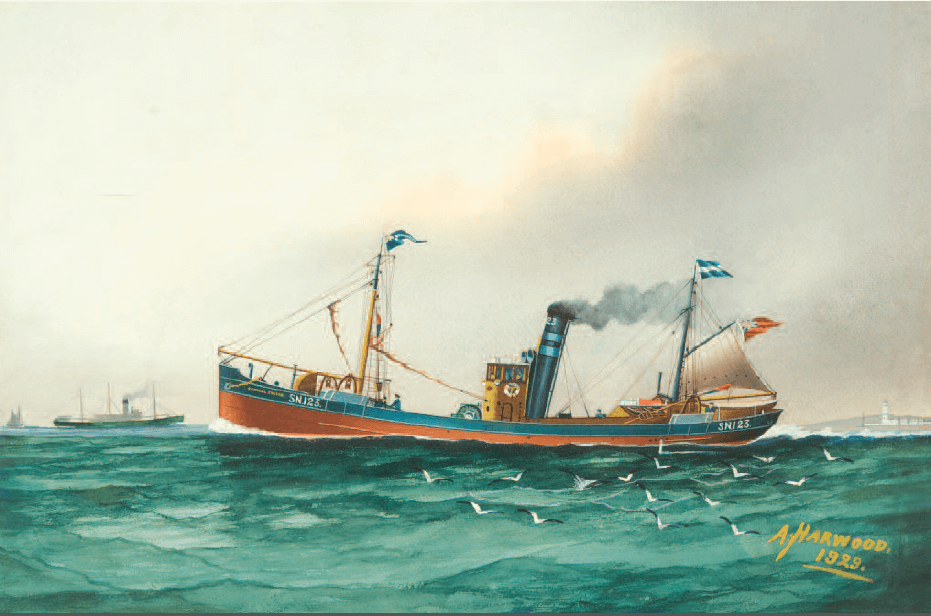
The steam trawler GENERAL JOFFRE SN123 was built in 1914 at Willington Quay on the Tyne for R. Irvin of North Shields, whose house-flag and funnel livery she is wearing in this portrait. From 1916-1919 she was requisitioned by the Admiralty as a minesweeper, following which she resumed fishing out of North Shields until 1951, when she was transferred to Milford Haven and was renamed and re-registered as SOUTHLEIGH M158.
By Alexander Harwood (1874-1943), a ‘lumper’, or porter, on the fish dock in Aberdeen, who himself served during the First World War aboard a trawler converted for minesweeping. He painted portraits of a great many of the fishing vessels he encountered, often in ‘fair weather’/’foul weather’ pairs, and this is the fair weather constituent of just such a pair of portraits.
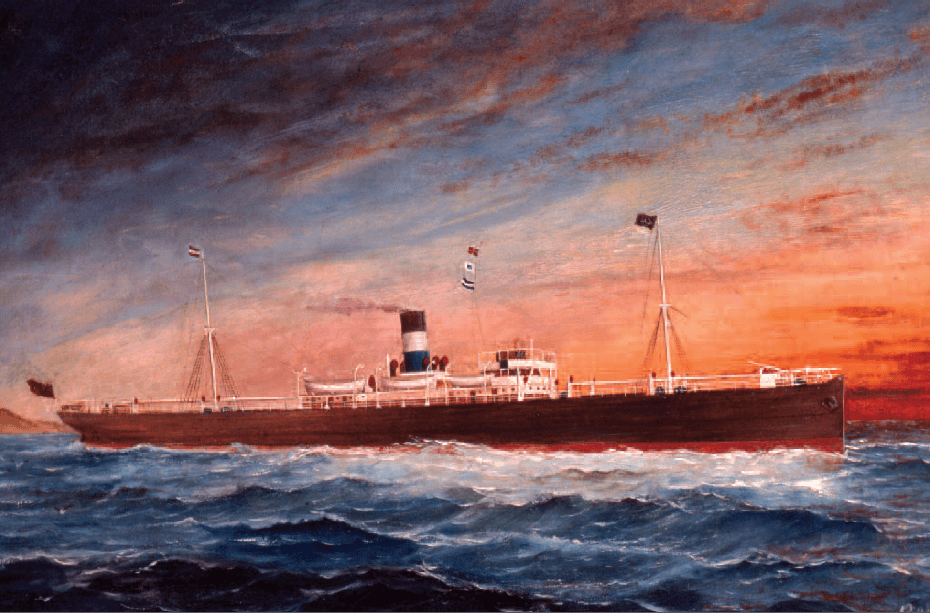
The passenger/cargo liner VERDI was built in 1907 by Workman, Clark & Co. Ltd. of Belfast for the Liverpool, Brazil & River Plate Steam Navigation Co. Ltd. of Messrs. Lamport & Holt & Co. of Liverpool, whose house-flag and funnel livery she is wearing in this portrait. In conformity with Lamport & Holt’s policy of naming their ships after eminent artists, philosophers, scientists and statesmen, VERDI was the first of what were to become two successive ships of the company to be named after the celebrated Italian opera composer Giuseppe Verdi (1813-1901). On 22nd August, 1917, while on passage from New York to Liverpool carrying general cargo, she was torpedoed and sunk by the German submarine
U.53 115 miles north west of Northern Ireland.
In this portrait attributed to the Spanish marine artist A.F. Portel, VERDI is shown against a dramatic sunset wearing at her foretopmasthead the ensign of Brazil in the traditional courtesy to the country of her next port of call and flying from her bridge halyards the three signal flags representing the letters R.S.J. This hoist is difficult to interpret: in the International Code of Signals in force from 1901-1931 – i.e. throughout VERDI’s lifetime – it has a meteorological connection but is incomplete and meaningless as it stands, yet in the preceding Commercial Code, in force from 1857-1900, it means “Thank you”, a sentiment which the artist might well have had occasion to express in his painting. In which event it would seem that, in so doing, he inadvertently had recourse to the Code which by then had been superseded for several years.
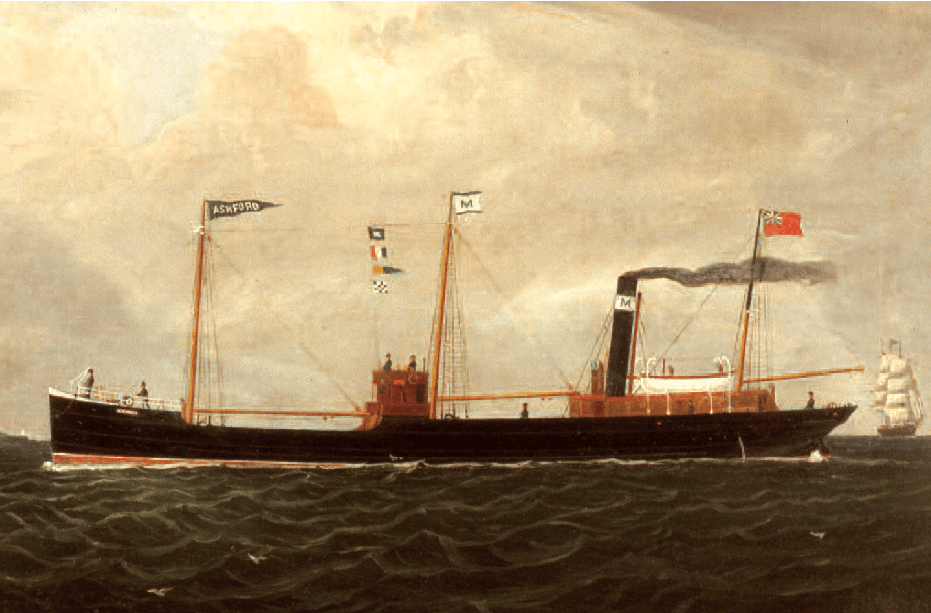
Built in 1892 by Scott & Co. of Bowling as ITHFAEN for Kneeshaw, Lupton & Co. of Liverpool, this steam coaster had already changed hands twice and was named MAGGIE BAIN when she was acquired in November, 1899 by Mann, Macneal & Co. of Glasgow, who renamed her ASHFORD. Sold on in 1915 to owners in Bray, County Wicklow, she was renamed BRAEFIELD and on 30th March, 1917 she cleared Cork for Cardiff in ballast and was never seen or heard of again. It is thought that she was torpedoed in the Bristol Channel by the German submarine U.57.
By the unrecorded, somewhat naive artist Robert P. Atkinson, all of whose other known works are also portraits of British steam coasters. Here he shows ASHFORD wearing her name pennant and the house-flag and funnel livery of Mann, Macneal & Co. and flying from her bridge halyards the four flags representing the letters P.T.G.N. of her identification hoist in the Commercial Code of Signals then in force.
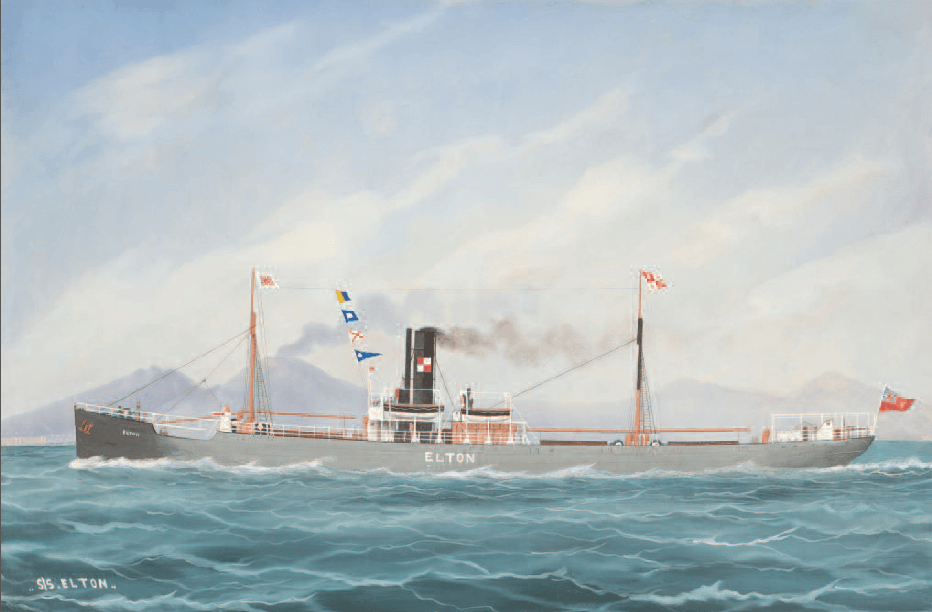
The well-deck tramp steamship ELTON was built in 1888 by William Gray & Co. Ltd. of West Hartlepool for R. Ropner & Co of that same port. In 1912 she was sold to William Coupland & Co. of Newcastle and she ended her days in 1915 when she was scuttled to block one of the seaways into the anchorage of the Royal Navy’s Grand Fleet at Scapa Flow.
In this portrait attributed to Luca Papaluca of Naples, ELTON is shown approaching that port with Mount Vesuvius on her starboard beam. At her foretopmasthead she is flying the Pilot Jack, a Union flag within a white border signifying “This ship is British and requires a pilot”, and at her bridge halyards the four flags representing the letters K.P.V.D. of her identification hoist in the International Code of Signals in force from 1901-1931. It so happened that when the International Code was created by the addition to the former Commercial Code of new flags representing the previously absent five vowels and the consonants ‘X’, ‘Y’ and ‘Z’, that for the fifth vowel, ‘U’, was constituted by a red-and-white check precisely similar to that shown in ELTON’s house-flag and funnel marking, but Robert Ropner’s adoption of the pattern since the formation of his company in 1874 was as the emblem of the town of Magdeburg where his father, a Prussian army officer, had been stationed during Robert’s early childhood. Amongst generations of British merchant seamen, however, it was known as “the old bread and jam”.
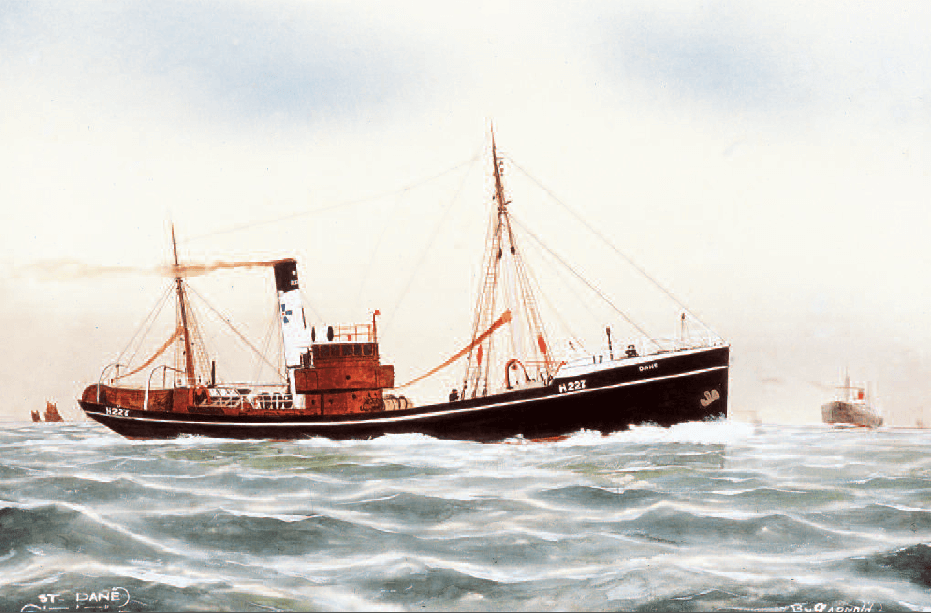
The trawler DANE H227 was built in 1911 by Cook, Welton & Gemmell Ltd. of Beverley for the Imperial Steam Fishing Co. Ltd. of Hull, in whose livery she is shown in this portrait. Subsequently she changed hands no fewer than seven times, working successively also out of Fleetwood, Grimsby and Granton as well as being requisitioned as a minesweeper in both World Wars, and she was eventually broken up in Granton in 1954.
By Joseph Arnold of Hull, who himself may have been a trawlerman and whose few but active years as a marine artist appear to have been confined within the second decade of the 20th century. Many of his ship-portraits were of steam fishing vessels, painted sometimes in ‘fair weather’/’fine weather’ pairs, and this is the fair weather constituent of just such a pair of portraits.
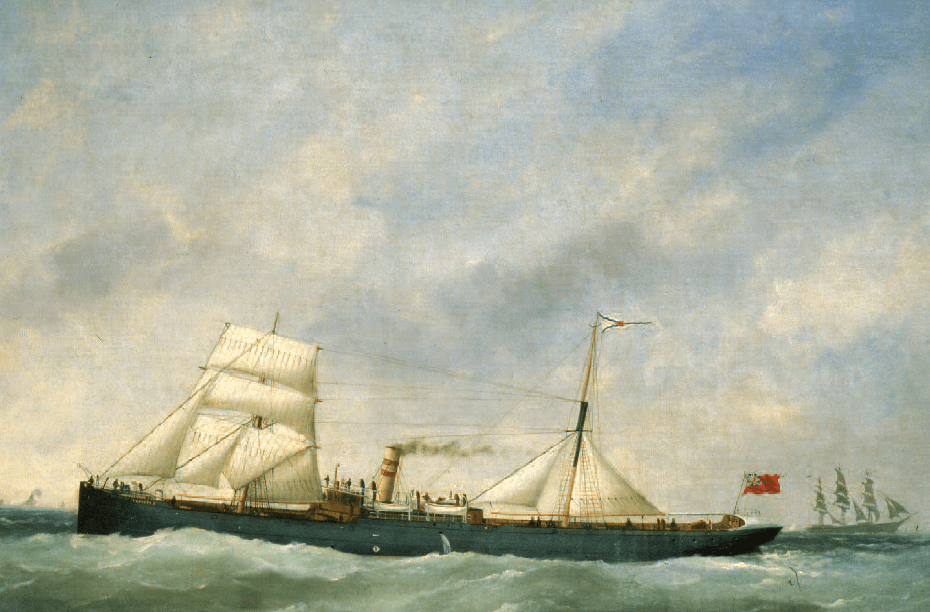
The brigantine-rigged tramp steamship ELVASTON was built in 1887 by Sir James Laing & Sons Ltd. of Sunderland for Messrs. Harris & Dixon of London, whose distinctive house-flag and funnel livery she is wearing in this portrait. Sold abroad in 1895, she was renamed three times before reverting to British registry, again as ELVASTON, in 1921 and it was as ELMSGARTH, also British, to which her name was changed yet again in 1924, that she was eventually broken up in Rosyth in 1933 after a working life of no fewer than 46 years.
By Edouard Adam, the holder of an official appointment as a marine artist to the French Government and a member of an extended family of ship-portrait painters who flourished in the prominent port of Le Havre from the 1870s up until the First World War.
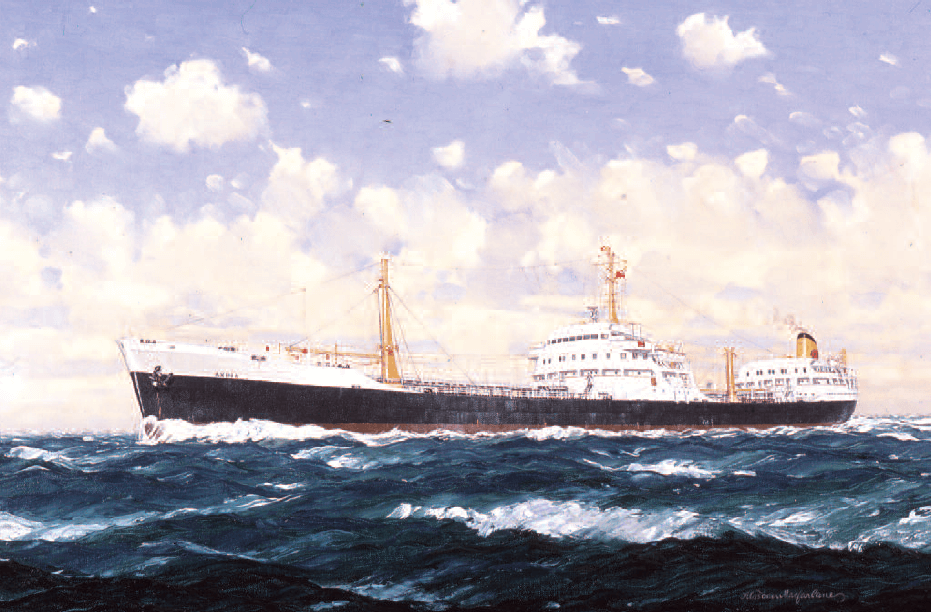
The steam turbine-propelled, crude oil tanker AXINA was built in 1958 by Lithgows Ltd. of Port Glasgow for the Shell Petroleum Co. Ltd. of London, she being one of ten vessels of the 19,000 dwt ‘A’ class completed between 1958 and 1960 and one of the final Shell tankers to embody the ‘three-island’ design of poop, midships structure and forecastle before the navigating bridge and its incorporated accommodation for deck officers was also situated aft. AXINA was sold in 1978 to be scrapped in Kaohsuing, Taiwan.
By the marine artist and illustrator Alasdair Macfarlane, who is known primarily for an exhibition held at the Greenock Arts Guild in January, 1980 of ship-portrait drawings that he executed in the 1950s. Here he shows AXINA wearing the house-flag and funnel livery adopted by Shell tankers between 1945 and 1963.
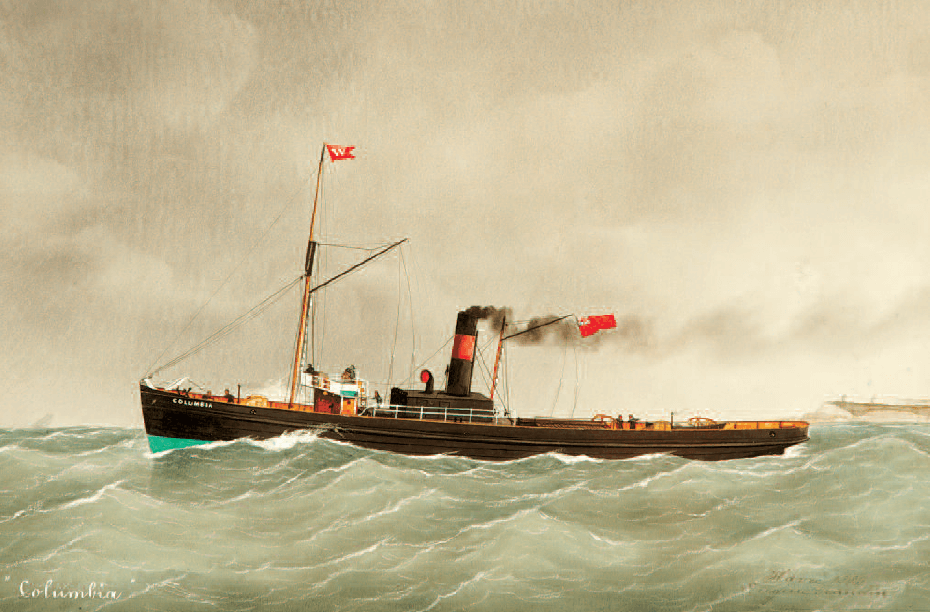
The screw tug COLUMBIA was built in 1884 at Delftshaven in Holland for arguably the most celebrated of all the many tug-operating companies of London River, William Watkins Ltd., whose house-flag, funnel livery and distinctive green boottopping are clearly to be seen in this portrait. Watkins were among the pioneers of ‘seeking’, the practice of sending tugs on speculative ventures often far beyond the confines of the Thames in the hope of encountering inbound sailing vessels happy to ‘take steam’ to get quickly and safely into dock. Inscribed ‘Havre’ and dated 1889, this portrait probably stems from the occasion in that year when, as
recorded in Frank C. Bowen’s centenary history of Watkins Ltd., ‘A Hundred Years of Towage, 1833-1933’, COLUMBIA picked up the barque DUNQUERQUE well down Channel and, to enable her to qualify for the generous subsidy being offered by the French Government at that period to commercial sailing ships which called at French ports, towed her first into Le Havre before taking her on to her actual destination, Cardiff.
By Eugène Grandin, a marine artist and draughtsman working in Le Havre from about 1850-1910.
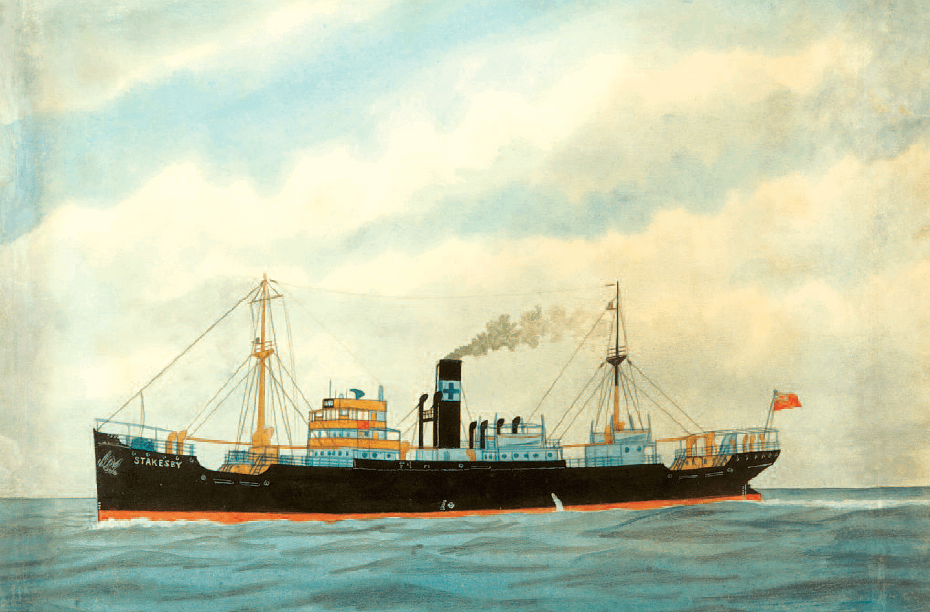
Although in marine circles the suffix ‘-by’, the Norse for village, was associated primarily with the names of ships owned by Ropners of West Hartlepool, the tramp steamship STAKESBY was owned by Headlam Steam Ship Co. Ltd. of Whitby, she having been built for them in 1930 by William Pickersgill Ltd. of Sunderland as their third successive vessel to bear that name. She was one of 14 ships owned by the company at the outbreak of the Second World War, no fewer than ten of which fell victim to enemy action. On 28th August, 1940 STAKESBY herself, while a member of convoy HX65 and carrying 7,000 tons of pit props, was torpedoed and set on fire by the German submarine U.124, but she was successfully towed to Stornoway and beached. In January, 1941 she was refloated and repaired and in 1943 she re-entered service as EMPIRE DERWENT. In 1946 she was renamed SWAN POINT and on 31st July, 1949 she ran aground off Chittagong and became a total loss.
By an unknown, almost certainly amateur artist, this portrait may be dated to 1934 or later, as previously the cross of Headlam’s funnel marking had been coloured red and in that year it was changed to blue in response to representations from the International Red Cross.
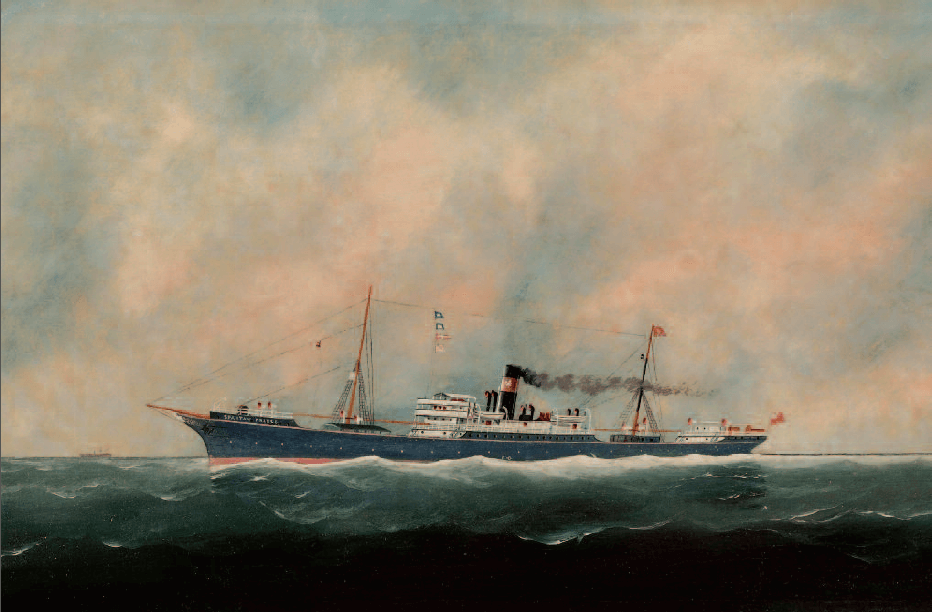
The clipper-stemmed tramp steamship SPARTAN PRINCE was built in 1897 by Short Brothers of Sunderland for the Prince Steam Shipping Co. Ltd., later Prince Line Ltd., of Newcastle, she being the first of what were to become three successive ships of the company to bear that name. On 29th August, 1908, while on passage from New York to the River Plate and 150 miles from Para, Brazil, she was abandoned and later sank following a collision with the barque TIMANDRA.
By the unrecorded ship-portrait artist W. Hooper, of whom no biographical details are known but who is thought to have worked in Hull. Here he shows SPARTAN PRINCE wearing her owners’ house-flag and funnel livery incorporating the distinctive Prince of Wales’ feathers and flying from her bridge halyards the four flags representing the letters P.W.F.V. of her identification hoist in the International Code of Signals in force from 1901-1931.
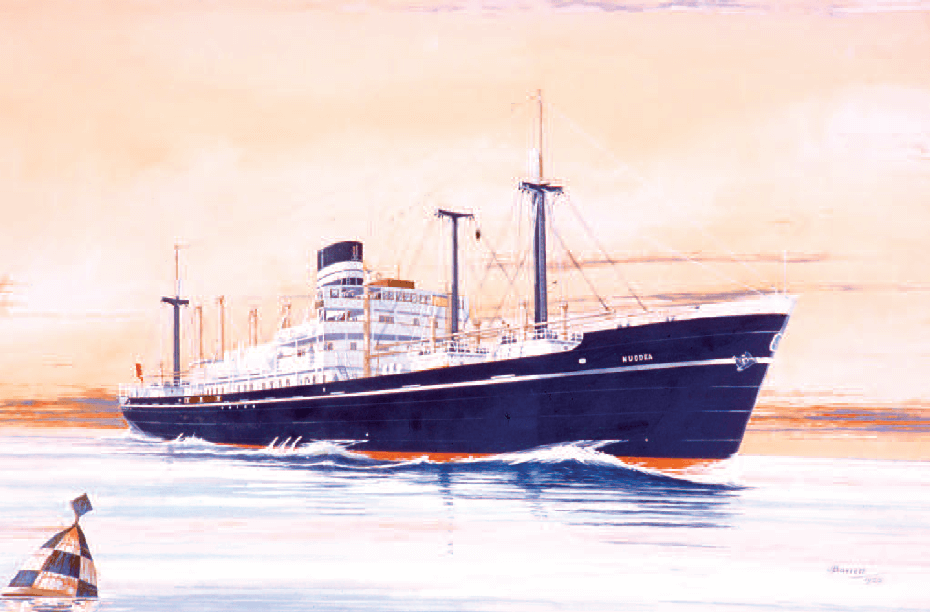
The cargo liner NUDDEA was built in 1954 by Barclay, Curle & Co. Ltd. of Whiteinch on the Clyde for the UK-Australia service of the British India Steam Navigation Co. Ltd. of London, she being the third and final successive ship of the company to bear that name. In 1964 she picked up off the Australian coast 22 Taiwanese fishermen whose boat had been destroyed by fire and later that same year she was in collision with the German coaster GERMANE in the Thames. In 1967 she was transferred to British India’s service between Japan and the Persian Gulf and in April, 1972, as part of a general regrouping, her ownership passed to BI’s parent company, the Peninsula & Orient Steam Navigation Co. In February of the following year, her
continuing operation having been rendered uneconomic by the then sharp rise in the price of oil, she was sold for demolition in Kaohsuing, Taiwan.
By the marine artist and illustrator J. Barrett, of whom no biographical details are known.